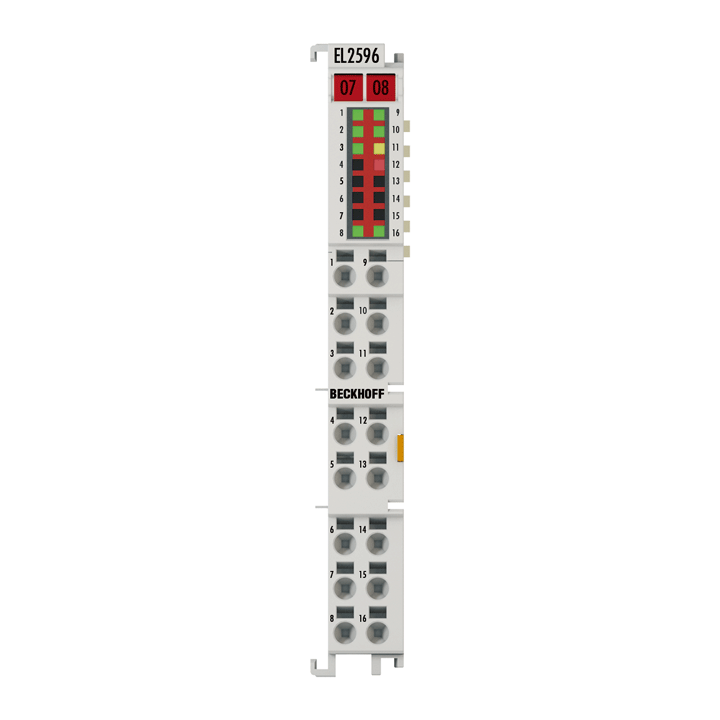
Beckhoff Automation GmbH & Co. KG EL2596
EL2596 EtherCAT Terminal, 1-channel LED output, 0â¦24 V DC, 3 A
Категории:
Технические характеристики
| Connection technology | 2-wire |
|---|---|
| Number of outputs | 1 |
| Напряжение питания | 24Â V DC (-15%/+20%) |
| Load type | LED (resistive) |
| Distributed clocks | yes |
| Distributed clock accuracy | << 1 µs |
| Напряжение питания | continuous light mode : 0â¦U IN continuous light operation PWM: 0â¦(U IN - 0.5 V) pulsed operation (0â¦2 A): 0â¦(U IN - 2 V) pulsed operation (3 A*): 0â¦(U IN - 3 V) *linear behavior of the maximum output voltage between 2 A and 3 A |
| Max. output current | 0â¦3 A in pulsed mode (depending on output voltage and duty cycle) 0â¦1.2 A in continuous mode |
| Switching times | typ. T ON : < 1 µs, typ. T OFF : < 1 µs, pulses from 25 µsâ¦10 s |
| Trigger output (to camera) | 1 (electrically isolated, max. 10 mA push-pull, 10â¦24 V DC, voltage adjustable via externally connectable voltage distributor) |
| Trigger input (from camera) | 1 (electrically isolated, typ. 3 mA, 4â¦24 V DC, switchable sensitivity) |
| Current consumption E-bus | typ. 240 mA |
| Current consumption power contacts | â |
| Electrical isolation | 500 V (E-bus/field potential) |
| Special features | constant voltage, constant current and PWM as available operating modes; extensive real-time diagnostics; connection option voltage divider TriggerOut; continuous LED operation; RGB/common anode operation |
| Масса | approx. 55 g |
| Operating temperature | 0â¦55°C |
| Storage temperature | -25â¦+85°C |
| Relative humidity | 95%, no condensation |
| Vibration/shock resistance | conforms to EN 60068-2-6/EN 60068-2-27 |
| EMC immunity/emission | conforms to EN 61000-6-2/EN 61000-6-4 |
| Protect. rating/installation pos. | IP20/see documentation |
| Approvals/markings | CE |
| Description | The EL2596 LED strobe control terminal contains a flexible power supply unit that supplies the LED with the required current and voltage. Applications from continuous light to short light pulses in the kHz range are thus possible. Each individual flash |