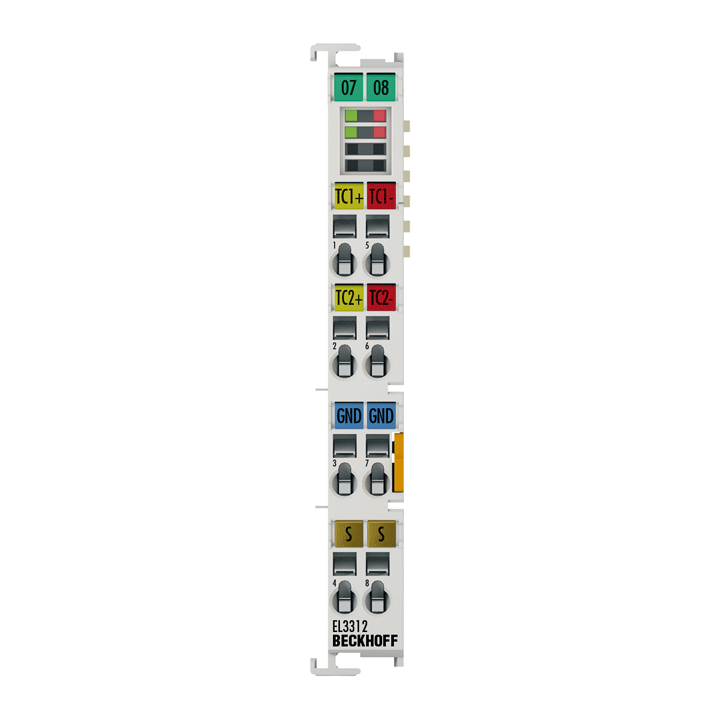
Beckhoff Automation GmbH & Co. KG EL3312
EL3312 EtherCAT Terminal, 2-channel analog input, temperature, thermocouple, 16 bit
Категории:
Технические характеристики
| Number of inputs | 2 |
|---|---|
| Power supply | via the E-bus |
| Distributed clocks | â |
| Input filter cut-off frequency | typ. 1 kHz |
| Connection technology | 2-wire |
| Conversion time | approx. 1.2 s up to 7 ms, depending on configuration and filter setting, default: approx. 125 ms |
| Напряжение питания | ±30/±60/±75 mV |
| Resolution | 16 bit, representation adjustable: 0.1/0.01°C or 1/2/4 µV per digit |
| Temperature measurement (thermocouple) | type B, C, E, J, K, L, N, R, S, T, U (default setting: type K) |
| Measurement uncertainty (temperature measurement) | at 23°C ambient temperature, with internal cold junction, according type: B: ±8.5°C; C: ±6.2°C; E: ±2.5°C; J: ±2.7°C; K: ±3°C; L: ±2.3°C; N: ±3°C; R: ±6.7°C; S: ±7.1°C; T: ±2.9°C; U: ±2.5°C; for further details see documentation |
| Напряжение питания | at ±75 mV, 23°C ambient temperature: < ±0.14% (relative to full scale value) |
| Electrical isolation | 500 V (E-bus/signal voltage) |
| Current consumption E-bus | 200 mA |
| Current consumption power contacts | â |
| Special features | channel by channel wire break detection, internal and external cold junction, firmware filter adjustable |
| Масса | approx. 60 g |
| Operating temperature | -25â¦+60°C |
| Storage temperature | -40â¦+85°C |
| Relative humidity | 95%, no condensation |
| Vibration/shock resistance | conforms to EN 60068-2-6/EN 60068-2-27 |
| EMC immunity/emission | conforms to EN 61000-6-2/EN 61000-6-4 |
| Protect. rating/installation pos. | IP20/variable |
| Approvals/markings | CE, CCC, UL, ATEX, IECEx, cFMus |
| Ex marking | ATEX: II 3G Ex ec IIC T4 Gc IECEx: Ex ec IIC T4 Gc cFMus: Class I, Division 2, Groups A, B, C, D Class I, Zone 2, AEx ec IIC T4 Gc |
| Description | The EL3312 analog input terminal allows thermocouples to be connected directly. The EtherCAT Terminal's circuit can operate thermocouple sensors using the 2-wire technology. Linearization over the full temperature range is realized with the aid of a |